004. What the Planets Mean in Astrology
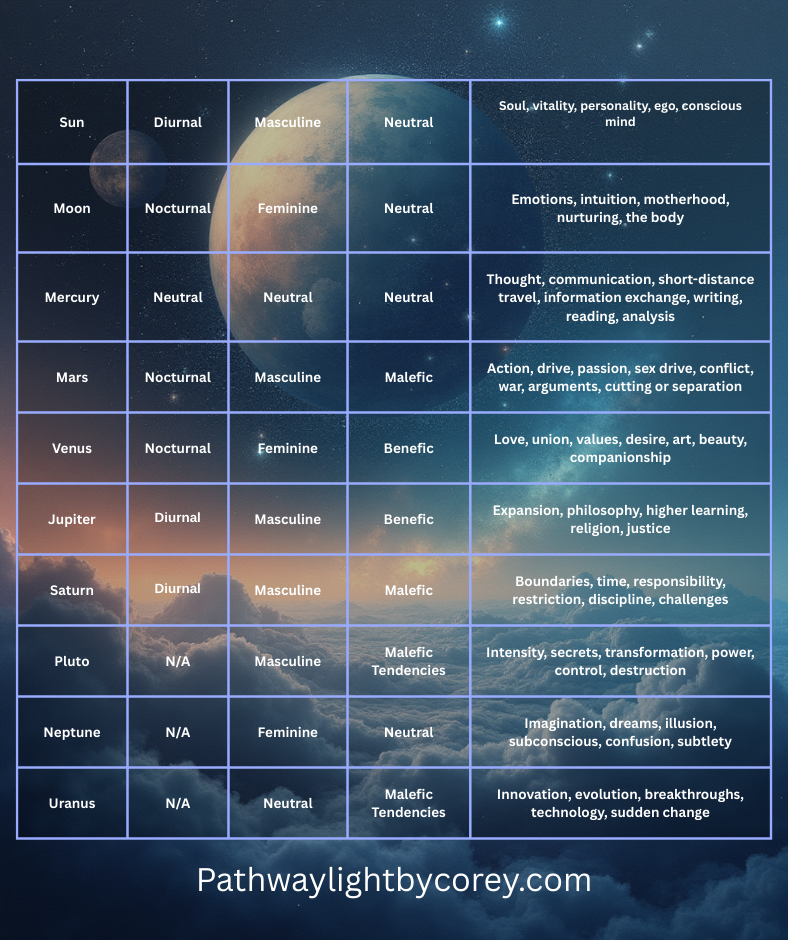
The ten planets in astrology are the moving pieces that shape our birth charts, natal placements, transits, and much more. They serve as archetypal representations of different parts of our lived experience. Each planet holds a gender, belongs to a sect by day or night, and carries specific attributes unique to that planet.
By understanding these layers of planetary meaning, we are able to create a fuller and more dynamic picture of our natal chart and how it functions.
Planetary Sect in Astrology: Day and Night Charts
Each of the seven traditional planets belongs to a specific sect, meaning they operate more cooperatively and effectively when placed in either a day chart or a night chart.
Diurnal (Day Sect) Planets
The planets and luminary that belong to the day sect are the Sun, Jupiter, and Saturn. These planets tend to be more content, active, and cooperative when positioned in a chart where the Sun is above the horizon.
This is determined by looking at the Ascendant and Descendant axis. If the Sun is above that axis, the chart is considered diurnal. In a day chart, Jupiter and Saturn are said to be more comfortable in their expression, while the nocturnal planets may be slightly less cooperative.
Nocturnal (Night Sect) Planets
The planets and luminary that belong to the night sect are the Moon, Venus, and Mars. These planets function more smoothly and express their qualities more effectively when the Sun is below the horizon.
If the Sun is below the Ascendant and Descendant axis, the chart is considered nocturnal. In these charts, Venus and Mars tend to be more cooperative and active in their expression.
Mercury and Planetary Sect
Mercury is considered neutral by nature. If Mercury rises before the Sun as a morning star, it is treated as diurnal. If Mercury appears after sunset as an evening star, it is considered nocturnal.
Understanding planetary sect is an important factor in determining how helpful, active, or challenged a planet may be within the natal chart.
Masculine and Feminine Planets in Astrology
The same core principles of masculine and feminine energy discussed in What to Start With When Studying Western Astrology (Beginner’s Guide) also apply to the planets.
Just as the zodiac signs carry gendered expression, so do the planets. Most Western astrology texts identify the masculine planets as the Sun, Jupiter, Saturn, and Mars. The feminine planets are the Moon and Venus.
Mercury once again holds a flexible position. When Mercury rises before the Sun, it is considered masculine. When it appears as an evening star after sunset, it is considered more feminine in expression.
Benefic and Malefic Planets: Planetary Attributes Explained
Each planet and luminary represents a specific set of life attributes. Some planets are traditionally considered malefic, meaning destabilizing or challenging, while others are considered benefic, meaning supportive or stabilizing.
Malefic planets tend to introduce tension, difficulty, or disruption, often pushing growth through challenge. Benefic planets provide opportunity, support, and general fortune within the natal chart. Neither classification is inherently good or bad. They describe how energy tends to manifest and be experienced.
By understanding each planet’s attributes, we unlock an essential part of the symbolic language of astrology.
Planetary Meanings, Sect, Gender, and Benefic or Malefic Nature

Corey Neulieb, Founder of Pathway Light by Corey
Corey Neulieb is a traditional astrologer, astrology educator, and consulting practitioner who has been studying and practicing astrology seriously since 2020. His work draws primarily from Western and Hellenistic traditions, with an emphasis on historical techniques, foundational symbolism, and experiential learning.
In addition to teaching and writing, Corey offers astrology consultations that focus on practical application, clarity, and long-term understanding. His consulting work informs his educational approach, grounding astrological concepts in lived experience and repeated observation rather than abstract theory alone.
Corey’s teaching philosophy centers on the belief that book study forms only part of the learning process. While structured study is essential, meaningful astrological understanding develops through experience—working with charts, tracking cycles, and reflecting on how symbolism manifests over time. Through writing, education, mentorship, and consultation, Corey aims to support students and clients in building a thoughtful, grounded, and enduring relationship with astrology.
