008. How to Understand Rulership in Astrology
Planetary rulership is one of the most prominent and significant factors when interpreting a natal chart. Outside of a placement’s sign and house, rulership is arguably the single most important consideration when assessing how a chart functions as a whole.
What Is Planetary Rulership?
Think of rulership like homeownership. Each planet is said to “own” certain signs, providing qualities that give the sign more depth and context. The planet sets the tone for how the sign expresses itself and how matters related to that sign are managed within the chart.
Take the sign of Cancer as an example. Cancer is a feminine, cardinal water sign associated with the phlegmatic temperament. Its ruler is the Moon, the luminary that governs nurturing, emotions, the subconscious, and in some cases the physical body. When these concepts are combined, Cancer emerges as a nurturing yet deeply emotional water sign. Its symbol, the crab, reflects themes of protection, sensitivity, and home, qualities that strongly mirror lunar archetypes.
How Rulership Works in a Natal Chart
When a planet rules a sign, it remains responsible for what happens in that sign regardless of where the planet itself is placed in the chart. Using the example above, if the Moon is in Pisces rather than Cancer, the Moon is still responsible for all matters occurring in Cancer. Any natal planets or transits in Cancer must look to the Moon for support, expression, and context.
This is why rulership is essential for understanding how different areas of the chart communicate with one another.
Traditional vs Modern Planetary Rulership
There are two primary rulership systems used in astrology: traditional rulership and modern rulership.
Traditional Rulership System
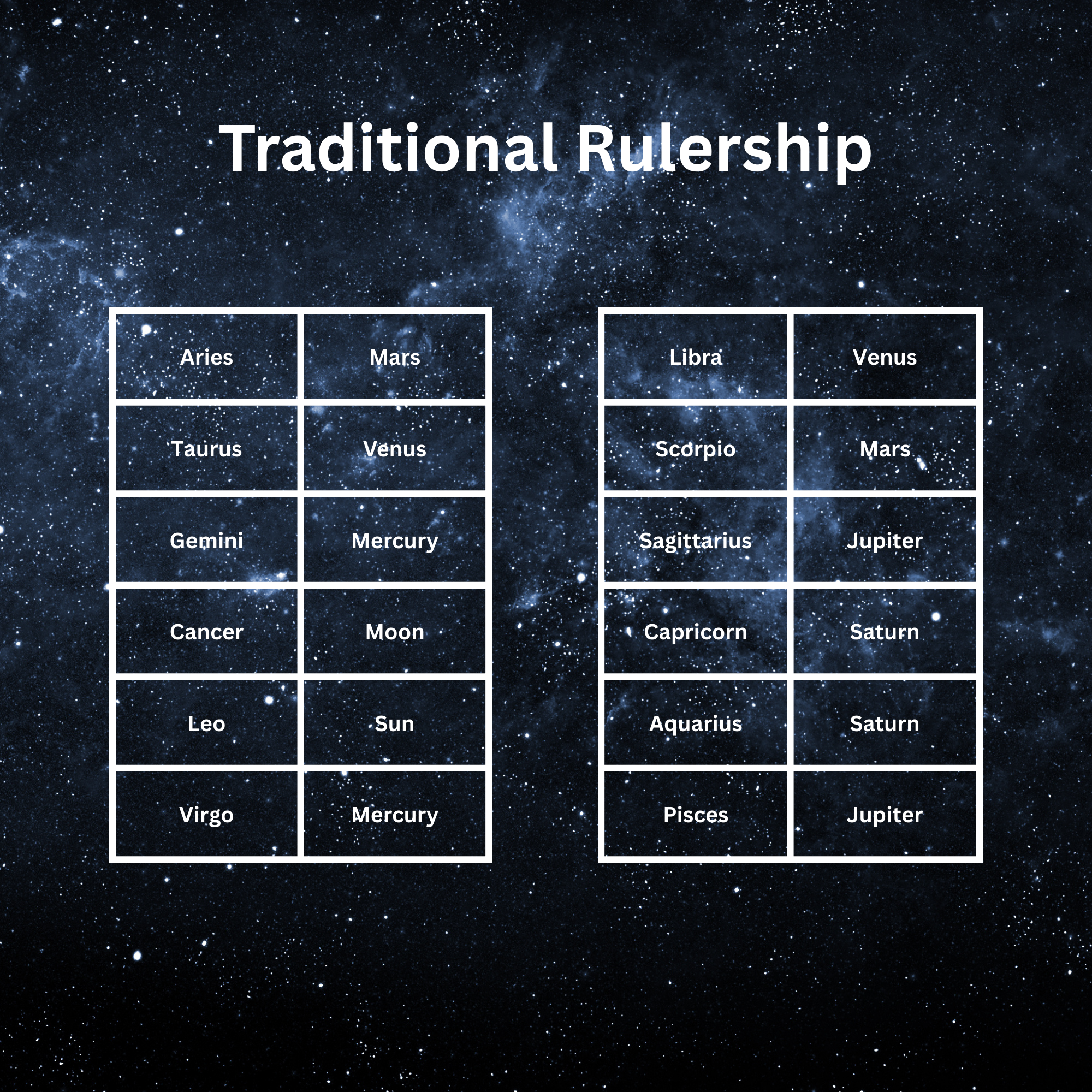
Before the invention of the telescope, astrologers could only observe the seven visible planets and luminaries:
the Sun, Moon, Mercury, Venus, Mars, Jupiter, and Saturn.
Using these bodies alongside frameworks such as the Thema Mundi and aspect doctrine, astrologers developed the traditional rulership model:
Traditional Planetary Rulership
Modern Rulership System
As telescopes advanced and the outer planets were discovered, astrologers began correlating these planets with historical events and generational trends. This led to the modern rulership model:
Modern Planetary Rulership
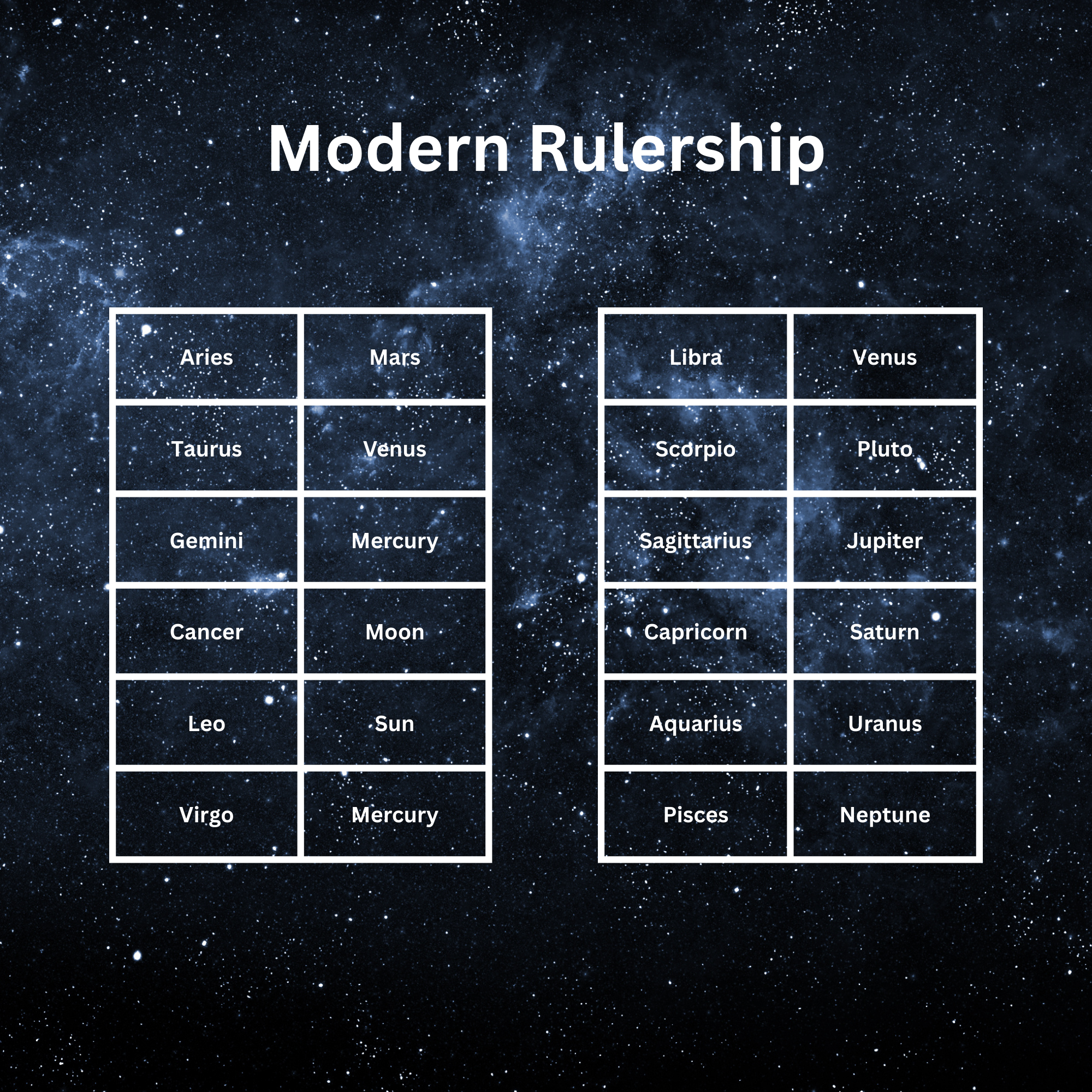
In this system, Scorpio is reassigned to Pluto rather than Mars, Aquarius to Uranus rather than Saturn, and Pisces to Neptune rather than Jupiter.
Using a Combined Rulership Approach
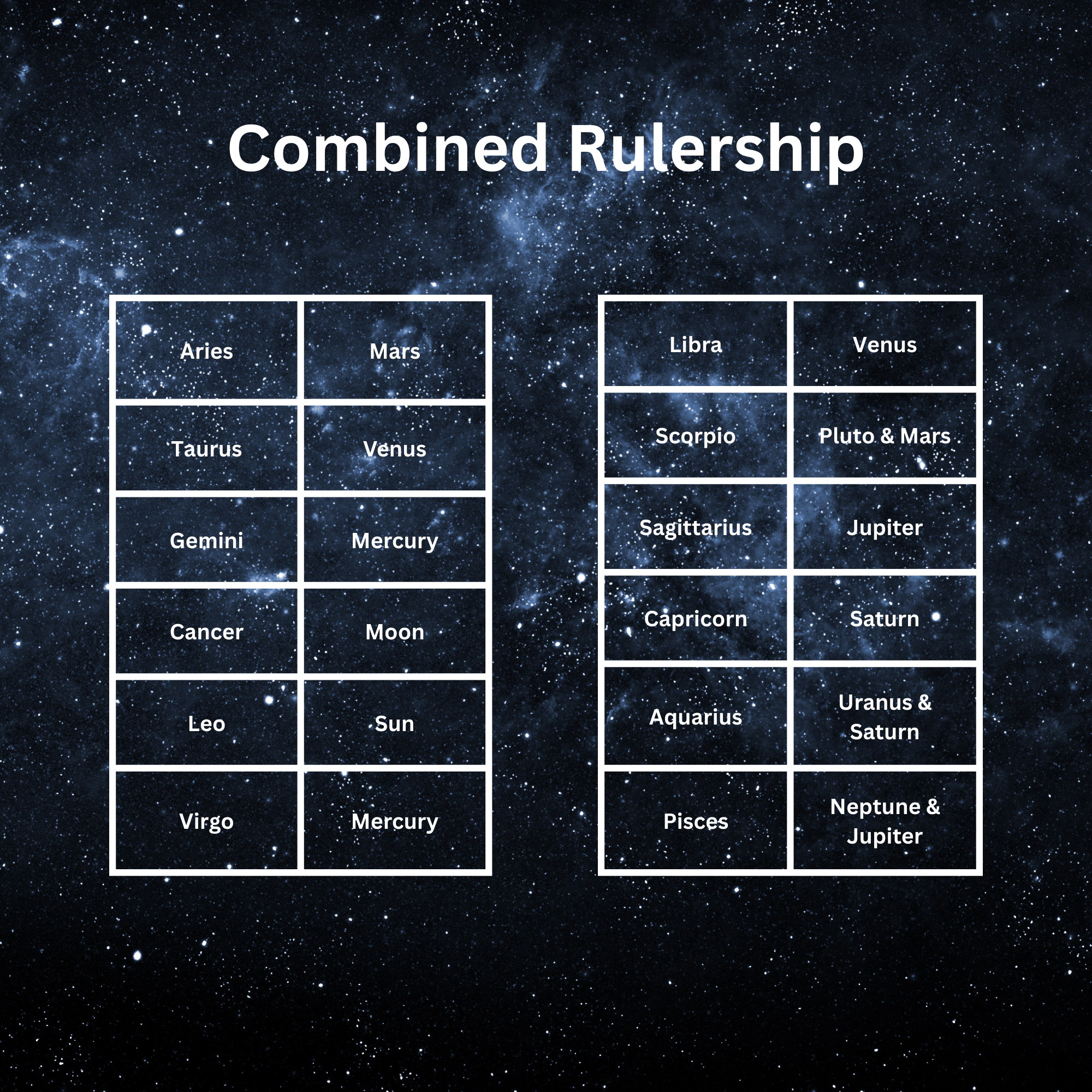
Given the centuries of observation supporting the traditional rulership system, I personally find it negligent to disregard it entirely. Instead, I apply a combined approach that incorporates both traditional and modern rulers.
Combined Planetary Rulership
Why Combined Rulership Matters
Using a combined rulership scheme reduces the risk of working within a limited interpretive scope. I have consistently found meaningful correlations between traditional and modern rulers operating simultaneously, offering a deeper and more nuanced understanding of how events unfold within the chart.
For example, if the 10th house of career falls in Aquarius, with Saturn placed in the 2nd house in Gemini and Uranus in Scorpio in the 7th house, career matters may be tied to 2nd house themes such as finances, skills, and resources, alongside 7th house Scorpio topics involving partnerships, shared power, intimacy, and contractual agreements.
Careers associated with this configuration may include couples financial advising, marital or divorce law, contract negotiation, or mediation work. Rulership provides the necessary context to move beyond surface-level interpretations and understand how different areas of the natal chart actively communicate with one another.

Corey Neulieb, Founder of Pathway Light by Corey
Corey Neulieb is a traditional astrologer, astrology educator, and consulting practitioner who has been studying and practicing astrology seriously since 2020. His work draws primarily from Western and Hellenistic traditions, with an emphasis on historical techniques, foundational symbolism, and experiential learning.
In addition to teaching and writing, Corey offers astrology consultations that focus on practical application, clarity, and long-term understanding. His consulting work informs his educational approach, grounding astrological concepts in lived experience and repeated observation rather than abstract theory alone.
Corey’s teaching philosophy centers on the belief that book study forms only part of the learning process. While structured study is essential, meaningful astrological understanding develops through experience—working with charts, tracking cycles, and reflecting on how symbolism manifests over time. Through writing, education, mentorship, and consultation, Corey aims to support students and clients in building a thoughtful, grounded, and enduring relationship with astrology.
